 admin
admin 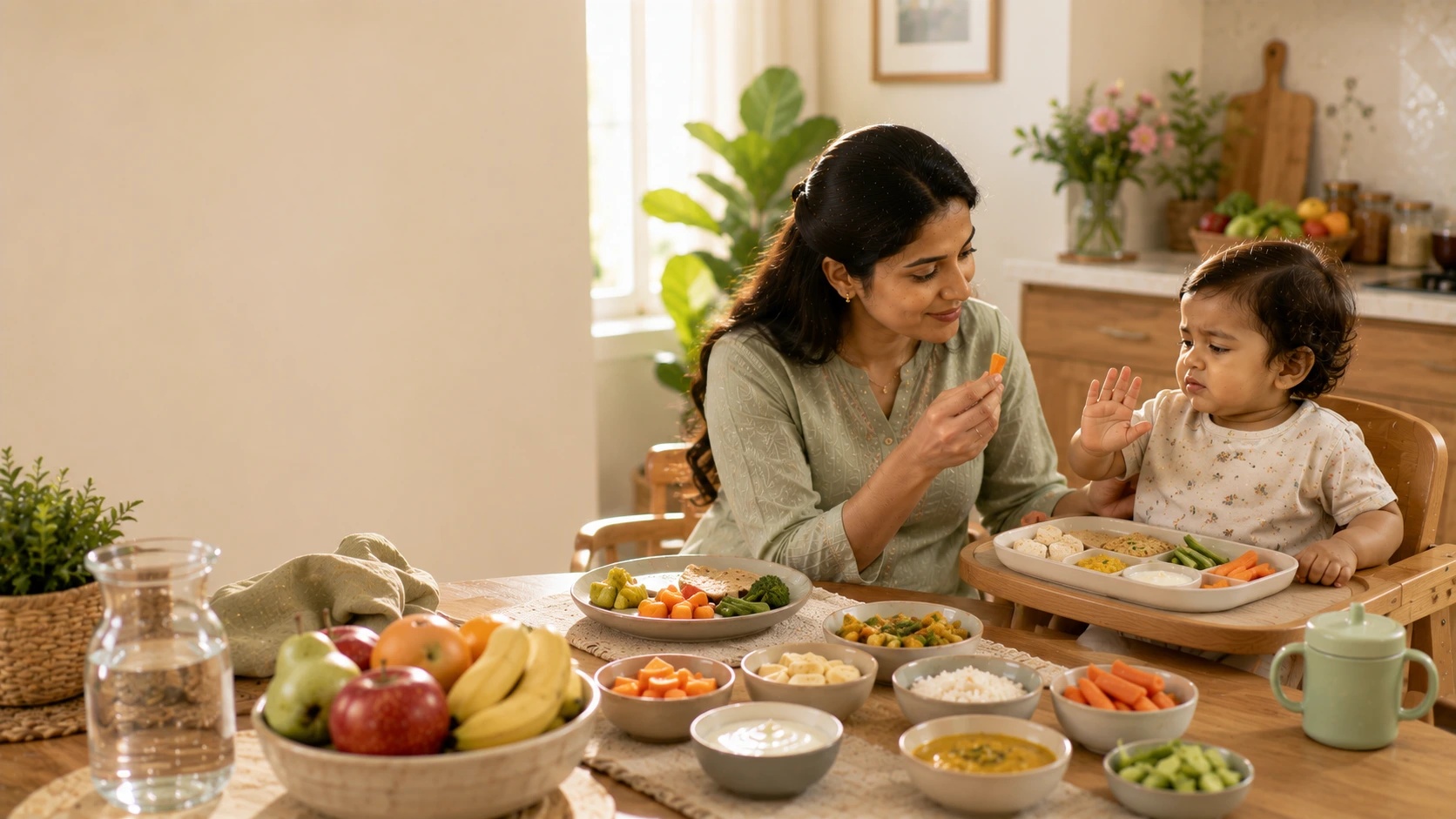
Your toddler happily ate dal, vegetables, and homemade khichdi last month. Now the same child turns away from the spoon, pushes the plate across the table, and says “No!” before even tasting the meal.
For many parents, food refusal creates immediate questions.
Is my child eating enough?
Am I offering the right foods?
Could my toddler be missing important nutrients?
Should I prepare something else?
Understanding toddler nutrition begins with recognizing that food refusal is not always a nutrition problem. Toddler eating behaviour is influenced by appetite, growth, independence, sensory preferences, familiarity with foods, daily routines, and the emotional environment surrounding meals.
A child who refuses vegetables at lunch, asks for milk an hour later, and happily eats a familiar snack in the evening is not necessarily rejecting food because they dislike eating. The behaviour may reflect changing appetite, preferences, or a desire for control.
For Indian families, the situation can become especially confusing when several caregivers are involved. Parents, grandparents, daycare staff, and relatives may all have different expectations about how much a toddler should eat.
One caregiver may believe the child needs another roti. Another may prepare a separate meal immediately after food is refused. A working parent may worry that relying on convenient foods means compromising on healthy food for toddlers.
The result is often more pressure on both the parent and the child.
A more supportive approach is to understand the real reasons behind food refusal and build eating routines that protect nutrition while allowing toddlers to develop confidence around food.
Why Toddlers Say “No” to Food
Toddlers refuse food for many reasons, and hunger is only one part of the explanation.
During the toddler years, children are developing rapidly. They are learning to communicate preferences, test boundaries, move independently, and influence what happens around them.
Food becomes one of the easiest areas where toddlers can exercise control.
A young child may not be able to decide when the family leaves home, which clothes they wear, or when bedtime begins. But they can close their mouth, turn their head, push away a plate, or say “No.”
This growing independence can influence healthy eating for toddlers even when parents consistently offer balanced meals.
Common Reasons Behind Toddler Food Refusal
| Reason | What Parents May Notice | What It Can Mean |
| Changing appetite | Eating well at one meal and very little at another | Hunger naturally varies across meals and days |
| Desire for independence | Saying “No” before tasting the food | The toddler may be testing control and autonomy |
| Food unfamiliarity | Refusing newly introduced vegetables or dishes | The child may need repeated exposure |
| Sensory preferences | Rejecting foods because of texture, smell, or appearance | The eating experience may feel unfamiliar |
| Too many snacks | Showing little interest in regular meals | The child may simply not be hungry |
| Large portions | Becoming overwhelmed when seeing a full plate | Smaller servings may feel easier to approach |
| Distractions | Eating only while watching a screen | The child may be paying less attention to hunger and fullness cues |
| Mealtime pressure | Crying, negotiating, or resisting the feeding chair | Eating may have become associated with tension |
Recognizing these patterns can help parents respond more calmly.
Food Refusal Does Not Always Mean Disliking the Food
One common misunderstanding is assuming that a toddler who refuses a food once does not like it.
Toddlers often need repeated opportunities to become comfortable with unfamiliar foods.
Imagine a two-year-old in Pune who regularly eats dal rice, banana, curd, and idli. The parents introduce lightly cooked beans for the first time.
The toddler touches the beans but refuses to eat them.
At the second meal, the child ignores them completely.
At the third exposure, the toddler takes one bite and removes it from their mouth.
Parents may interpret these reactions as failure. From a developmental perspective, however, the child is becoming familiar with the food.
Seeing, touching, smelling, tasting, and eventually eating unfamiliar foods are all parts of learning.
This is why variety remains important in toddler meal planning.
Parents can continue serving a small amount of an unfamiliar food alongside something the child already accepts.
For example:
- Dal rice + soft beans
- Idli + cooked carrot strips
- Curd rice + soft peas
- Vegetable paratha + plain curd
- Khichdi + a small portion of cooked vegetables
The goal is not to make the toddler finish every food.
The goal is to create repeated, pressure-free opportunities for learning.
Parent Scenario: “My Toddler Only Wants Familiar Foods”
Ritika is a working mother whose two-and-a-half-year-old son regularly asks for plain dosa, banana, curd rice, and biscuits.
Whenever she prepares vegetables or a new family meal, he refuses.
Worried that he will remain hungry, Ritika immediately prepares dosa or offers biscuits.
Her response is understandable. She wants her child to eat.
However, the toddler gradually learns an unintended pattern:
Refuse the unfamiliar meal → receive the preferred food.
A more balanced strategy would be to include one familiar food with the family meal.
For example:
| Instead of | Try |
| Replacing vegetable khichdi with biscuits | Serve a small portion of vegetable khichdi with familiar curd |
| Making plain dosa after the family meal is refused | Include a small piece of dosa alongside the original meal |
| Offering repeated snacks after lunch refusal | Maintain the regular snack routine |
| Asking for “just three more bites” repeatedly | Allow the toddler to decide how much to eat from the foods offered |
This approach protects food variety without turning mealtimes into negotiations.
Quick Takeaway for Parents
When a toddler says “No” to food:
✓ Stay calm.
✓ Avoid immediately replacing the meal.
✓ Offer at least one familiar food when possible.
✓ Keep portions manageable.
✓ Continue exposing the child to different foods.
✓ Look at eating patterns across several days rather than judging one meal.
Supporting healthy eating habits for kids requires consistency, but consistency does not mean forcing children to eat.
It means creating predictable opportunities for toddlers to explore food safely and gradually.
Appetite Changes During Toddlerhood
One of the biggest reasons parents become concerned about food refusal is that toddler appetite often looks very different from infant appetite.
During infancy, babies experience rapid growth and may eat frequently.
As children enter toddlerhood, their growth rate changes. Their appetite may become less predictable, and the amount they eat can vary significantly between meals and across different days.
A toddler may eat two servings of khichdi at lunch on Monday and only a few spoonfuls of the same meal on Tuesday.
This variability can be a normal part of development.
Understanding these changes helps parents build realistic expectations around a balanced diet for toddlers.
What Toddler Appetite Can Look Like
| Eating Pattern | Common Parent Interpretation | More Helpful Perspective |
| Large breakfast, small lunch | “My toddler is not eating properly.” | Appetite can vary throughout the day |
| Eating less than last month | “Something must be wrong.” | Growth patterns and energy needs can change |
| Asking for food shortly after refusing dinner | “My child is manipulating me.” | Snack timing, preferences, or meal structure may influence hunger |
| Eating well at daycare but refusing food at home | “My child dislikes my cooking.” | Environment and routines can influence eating behaviour |
| Eating one food repeatedly | “My child will never eat variety.” | Familiar foods can provide security while new foods are introduced gradually |
Look at the Week, Not One Meal
Parents often evaluate toddler nutrition meal by meal.
A child refuses lunch, and the parent immediately worries about nutrition.
A more useful approach is to look at eating patterns across several days.
For example, a toddler may eat:
Monday: dal rice, banana, curd, and vegetable paratha.
Tuesday: idli, milk, rice, and fruit.
Wednesday: poha, dal khichdi, paneer, and curd.
Thursday: dosa, fruit, rice, and vegetables.
No single day may look perfectly balanced.
But across several days, the child may receive a much broader variety of foods.
The Appetite Cycle Parents Should Understand
Toddler eating behaviour often follows a simple cycle:
Regular meals and snacks → natural hunger develops → food is offered → toddler decides how much to eat → meal ends → next eating opportunity arrives.
Problems can arise when children continuously graze throughout the day.
Frequent biscuits, packaged drinks, milk, juice, or small snacks between scheduled eating opportunities can reduce hunger at regular meals.
Parents may then assume the child dislikes healthy toddler food, when the child simply may not be hungry.
Practical Appetite Checklist
Before worrying about how much your toddler ate, ask:
□ When was the last meal or snack?
□ Has my toddler been drinking milk or other beverages frequently?
□ Was the portion appropriate for a young child?
□ Did I offer at least one familiar food?
□ Was the eating environment calm?
□ Am I evaluating one meal instead of the overall weekly pattern?
□ Is my child generally active and developing as expected?
This simple checklist helps shift attention from “How do I make my child eat more?” to “How do I create conditions that support responsive eating?”
Parent Insight: Small Appetites Need Nutrient-Conscious Opportunities
Because toddlers may eat relatively small amounts at each meal, parents often benefit from focusing on variety and thoughtful food choices rather than simply increasing quantity.
Depending on family preferences and age appropriateness, meals and snacks may include foods such as:
- Dal and soft rice
- Khichdi with vegetables
- Curd
- Paneer
- Soft-cooked vegetables
- Fruits
- Idli
- Poha
- Upma
- Egg where included in the family’s diet
- Nut or seed preparations served in age-appropriate forms
- Healthy snacks for toddlers selected with ingredient transparency in mind
Many modern families also seek convenient nutrition options that fit busy routines without making ingredient quality harder to understand. Tiny Tums supports this trust-first approach by focusing on preservative-free nutrition, transparent ingredients, and parent-friendly choices that can complement balanced family eating routines.
The purpose of convenience should be to support healthy routines, not replace dietary variety.
When parents understand normal appetite changes, food refusal becomes easier to interpret.
Instead of asking, “How can I make my toddler finish the plate?” a more constructive question is:
“How can I consistently offer nourishing foods while allowing my child to listen to hunger and fullness cues?”
That shift is an important foundation for positive toddler nutrition and calmer family mealtimes.
Developmental Independence and Food
Toddlerhood is a period of rapid emotional, social, and cognitive development. Children begin to understand that they are separate individuals with preferences, opinions, and the ability to influence what happens around them.
Food is one of the most accessible ways toddlers can express this growing independence.
A two-year-old cannot decide the family’s schedule or whether they need to attend daycare. However, they can refuse a spoonful of dal, ask for a different cup, insist on eating without help, or reject a food they enjoyed yesterday.
These behaviours can feel frustrating for parents, especially when they are trying to provide balanced toddler nutrition.
However, resistance around food does not always mean the child dislikes the meal. Sometimes, the toddler is simply communicating:
“I want to decide.”
“I want to do it myself.”
“I want something familiar.”
“I want to know what happens when I say no.”
Understanding this developmental need for autonomy can help parents respond without turning meals into repeated power struggles.
Why Food Becomes a Control Point
Adults control many aspects of a toddler’s day.
Parents decide:
- When the child wakes up
- When they leave home
- When they go to daycare
- What clothes are available
- When screens are allowed
- When bath time begins
- When bedtime happens
- What food is served
The toddler controls very few of these decisions.
But the child can control whether food enters their mouth.
This is why repeatedly commanding, negotiating, bribing, or forcing a toddler to eat can intensify resistance.
The more pressure parents apply, the more important refusing food may become to the child.
A supportive approach to healthy eating for toddlers gives children appropriate choices without allowing them to control the entire family menu.
Controlled Choices Can Reduce Mealtime Conflict
Toddlers often respond better when they are offered limited choices.
Instead of asking:
“What do you want for dinner?”
Parents can ask:
“Would you like banana or papaya with your snack?”
“Would you like curd or paneer with your meal?”
“Would you like the green bowl or the yellow bowl?”
“Would you like to eat the idli whole or cut into pieces?”
These choices allow toddlers to experience independence while parents continue to guide food availability.
| Unlimited Choice | Controlled Choice |
| “What do you want to eat?” | “Would you like idli or poha?” |
| “Tell me what I should make.” | “Would you like curd or paneer with lunch?” |
| “You can eat anything you want.” | “You can choose between these two snack options.” |
| “Finish your vegetables first.” | “You can decide which food on your plate you want to taste first.” |
Controlled choices support autonomy without compromising the overall structure of toddler meal planning.
Parent Scenario: The Two-Dinner Routine
Ananya prepares vegetable dal khichdi for her three-year-old daughter.
Her daughter looks at the bowl and immediately says, “I don’t want this. I want noodles.”
Ananya worries that her daughter will go to bed hungry, so she prepares noodles.
The next evening, the toddler refuses dinner again and asks for another preferred food.
Within a few weeks, Ananya finds herself preparing separate meals almost every evening.
This pattern is common because parents naturally want their children to eat.
However, repeatedly replacing refused meals may teach toddlers that rejecting food is an effective way to receive preferred alternatives.
A more balanced response could be:
“Tonight we are having khichdi. You can choose whether you want curd or some soft vegetables with it.”
The parent maintains the meal boundary while giving the toddler an appropriate choice.
A Simple Parent Decision Framework
When a toddler refuses food, parents can use the following sequence:
Pause → Observe → Offer Choice → Maintain Structure → Move On Calmly
Pause: Avoid immediately preparing another meal.
Observe: Consider whether the child is hungry, tired, distracted, uncomfortable, or overwhelmed.
Offer Choice: Provide a small choice within the available meal.
Maintain Structure: Keep the regular meal and snack routine.
Move On Calmly: End the meal without turning food refusal into a prolonged emotional event.
This approach supports healthy eating habits for kids while reducing repeated negotiation.
Practical Takeaway
Parents do not need to eliminate toddler independence.
The goal is to guide it.
When children receive age-appropriate choices within predictable routines, they can develop autonomy while continuing to experience different foods and balanced eating opportunities.
Texture, Smell and Appearance Factors
Adults often evaluate food primarily by taste.
Toddlers experience food differently.
Before tasting a meal, a young child may respond to:
- Colour
- Shape
- Temperature
- Smell
- Texture
- Moisture
- Stickiness
- How foods touch each other
- Whether the food looks familiar
These sensory characteristics can strongly influence food acceptance and overall toddler nutrition.
A toddler may happily eat raw cucumber but reject cooked cucumber.
The same child may eat mashed potato but refuse potato pieces.
Another child may eat plain rice and dal separately but refuse khichdi because the combined texture feels unfamiliar.
Food refusal can therefore reflect sensory preferences rather than a simple dislike of the ingredient itself.
Why Texture Matters During Toddlerhood
Children gradually learn to manage different food textures.
Soft foods, mashed foods, lumpy foods, finger foods, mixed dishes, chewy foods, and crisp textures all create different eating experiences.
Toddlers who are familiar with only a limited range of textures may need more time and repeated opportunities to accept unfamiliar foods.
This is one reason variety matters when choosing the best foods for toddlers.
The goal is not to introduce as many foods as possible at once.
Instead, parents can gradually expose children to different textures while keeping meals comfortable and age-appropriate.
One Food, Different Experiences
| Food | Different Ways It May Be Offered |
| Potato | Mashed, soft cubes, paratha filling, mixed into vegetables |
| Carrot | Soft sticks, grated into paratha, cooked pieces, added to khichdi |
| Paneer | Soft cubes, crumbled, mixed into paratha, added to vegetables |
| Banana | Mashed, slices, mixed with porridge, served as a soft finger food |
| Dal | Thin consistency, thicker dal, mixed with rice, served separately |
| Idli | Whole, small pieces, lightly mashed, served with curd |
Offering familiar ingredients in different forms can help expand a child’s food experience.
Smell Can Influence Food Acceptance
Indian cooking includes many aromatic spices, vegetables, dals, and preparations.
Adults may find the smell of tadka, vegetables, or spices appealing because these aromas are familiar.
A toddler experiencing the same smell for the first few times may react differently.
Strong aromas can make some children hesitant to taste a food.
Parents can introduce new flavours gradually rather than assuming children must immediately enjoy the same intensity of flavour preferred by adults.
Appearance Shapes Expectations
Young children often prefer foods they recognize.
Small visual changes can influence acceptance.
A toddler who regularly eats plain idli may refuse vegetable idli because the colour looks different.
A child who eats dal and rice separately may hesitate when the foods are mixed.
Another toddler may refuse fruit because it has been cut differently from usual.
This does not mean parents should serve food exactly the same way every day.
It means unfamiliar presentations may require time.
Familiarity Bridge Strategy
Parents can use a “familiarity bridge” when introducing foods.
Familiar food + small change + repeated exposure
Examples:
| Familiar Food | Small Change |
| Plain dosa | Add a small amount of vegetable filling |
| Dal rice | Place one soft vegetable beside the meal |
| Plain curd | Add a small amount of mashed fruit |
| Idli | Offer with a different familiar accompaniment |
| Plain paratha | Gradually introduce vegetable fillings |
This approach can help children move from familiar foods toward greater dietary variety.
Parent Scenario: “My Child Refuses Mixed Foods”
Rohan’s two-and-a-half-year-old daughter eats rice, dal, curd, and vegetables separately.
However, she refuses vegetable khichdi.
Her parents worry because khichdi seems like an ideal option for healthy food for toddlers.
Instead of forcing her to eat mixed foods, the family continues offering the ingredients separately while occasionally placing a small spoonful of khichdi on the plate.
Over time, the child can explore the mixed texture without pressure.
The objective is not immediate acceptance.
The objective is familiarity.
Practical Sensory Checklist
When a toddler repeatedly refuses a food, parents can ask:
□ Is the texture unfamiliar?
□ Is the smell stronger than foods the child usually eats?
□ Is the portion too large?
□ Are several unfamiliar foods being introduced together?
□ Does the food look significantly different from previous meals?
□ Is the child being given opportunities to touch and explore the food?
□ Could the temperature be uncomfortable?
□ Have I offered the food more than once without pressure?
These questions can help parents understand food refusal more accurately.
How Mealtime Pressure Backfires
When toddlers repeatedly refuse food, parents naturally become concerned.
Concern can gradually lead to pressure.
“Just eat three more bites.”
“Finish your vegetables first.”
“No dessert until the plate is empty.”
“Look, your friend eats everything.”
“Mama worked hard to make this.”
“If you don’t eat, you won’t grow.”
These statements often come from care, frustration, or worry about nutrition for growing children.
However, repeated pressure can change the emotional meaning of mealtimes.
Instead of learning to explore food, toddlers may learn that eating is connected with conflict, negotiation, rewards, or adult approval.
The Pressure-Resistance Cycle
Mealtime conflict can develop through a predictable pattern:
Parent worries about food intake → Parent pressures child to eat → Child resists → Parent becomes more concerned → Pressure increases → Child becomes more resistant
Breaking this cycle requires changing the feeding environment, not simply finding a more persuasive way to make the toddler eat.
Do vs Don’t: Responding to Food Refusal
| Don’t | Do |
| Force the child to take another bite | Allow the child to decide how much to eat from the foods offered |
| Prepare a preferred replacement immediately | Include a familiar food within the planned meal |
| Use sweets as a reward | Keep foods emotionally neutral |
| Compare the toddler with siblings or other children | Recognize that appetite and food acceptance vary |
| Follow the child around with food | Create predictable seated eating opportunities |
| Use screens to make the child eat more | Encourage attention to food and family interaction |
| Serve very large portions | Begin with manageable portions and offer more if wanted |
| Stop offering a food after one refusal | Continue gentle, repeated exposure |
| Discuss the child’s eating negatively in front of them | Use calm, neutral language around food |
| Judge nutrition from one meal | Observe overall eating patterns across several days |
Why Bribing With Food Can Become Counterproductive
Parents sometimes say:
“Finish your vegetables and then you can have chocolate.”
The immediate result may be that the toddler eats the vegetables.
However, the child may also learn two unintended lessons:
Vegetables are something unpleasant that must be completed.
Chocolate is more desirable because it is the reward.
Over time, this can make balanced eating more difficult.
A better approach is to avoid turning everyday foods into rewards or punishments.
Why “Just One More Bite” Can Become a Daily Battle
Asking for one additional bite may seem harmless.
Occasionally, gentle encouragement is unlikely to define a child’s overall relationship with food.
The problem arises when every meal becomes a negotiation.
One bite becomes three bites.
Three bites become “finish half the bowl.”
The toddler learns that saying “I’m done” does not end the eating experience.
Supporting healthy eating for toddlers includes helping children gradually recognize hunger and fullness cues while parents maintain responsibility for what foods are offered and when eating opportunities occur.
Picky Eating Myths vs More Helpful Perspectives
| Myth | More Helpful Perspective |
| “A good toddler finishes the plate.” | Appetite varies, and finishing food is not the only measure of successful eating |
| “If my toddler refuses vegetables, I should stop serving them.” | Familiarity often develops through repeated, pressure-free exposure |
| “Hungry children will eat anything.” | Hunger does not automatically remove sensory preferences or developmental resistance |
| “Preparing another meal is the easiest solution.” | Frequent replacements can unintentionally strengthen food refusal patterns |
| “Parents must control how much toddlers eat.” | Parents can structure meals while children respond to hunger and fullness |
| “Healthy eating means every meal must be balanced.” | Dietary variety is better evaluated across several meals and days |
| “Convenient foods cannot fit into good nutrition routines.” | Carefully selected convenient options can support busy families when ingredient transparency, age appropriateness, and overall variety are considered |
Parent Scenario: The Screen Feeding Routine
Meera’s three-year-old son refuses to sit at the dining table.
To make sure he eats enough, she plays cartoons on a phone and feeds him while he watches.
The routine initially feels helpful because the child finishes more food.
Over time, however, Meera notices that her son rarely communicates whether he is hungry or full during meals. Without the screen, he becomes restless and asks to leave.
Changing this pattern may require gradual adjustments rather than suddenly expecting perfect seated meals.
The family could begin by:
- Reducing screen time during one eating opportunity each day.
- Serving a small, manageable portion.
- Sitting together when possible.
- Keeping the meal duration predictable.
- Allowing the meal to end calmly when the child is finished.
- Maintaining the next planned meal or snack opportunity.
Consistency matters more than immediate perfection.
A Practical Parent Response Framework
When your toddler refuses food, try:
Offer → Observe → Stay Neutral → Maintain Routine → Reoffer Later
Offer: Provide an age-appropriate meal that includes some familiarity and variety.
Observe: Notice hunger, fullness, sensory responses, tiredness, and behaviour.
Stay Neutral: Avoid bargaining, threatening, bribing, or showing excessive disappointment.
Maintain Routine: Do not turn food refusal into continuous grazing or repeated replacement meals.
Reoffer Later: Continue exposing the child to foods across future meals without pressure.
Quick Checklist: Is Mealtime Pressure Increasing?
Parents can ask themselves:
□ Do I repeatedly ask my toddler to take more bites?
□ Do I become visibly anxious when food is left on the plate?
□ Do I regularly prepare a second meal after food refusal?
□ Do I use screens primarily to increase food intake?
□ Do I offer sweets or preferred snacks as rewards for eating?
□ Do I compare my child’s eating with siblings or other children?
□ Do I discuss my toddler as a “bad eater” in front of them?
□ Do I focus more on quantity eaten than the overall eating experience?
If several answers are yes, the goal is not to feel guilty.
It is to gradually create a calmer and more predictable feeding environment.
Practical Takeaway
Reducing pressure does not mean removing structure.
Parents still decide what foods are available, when meals and snacks happen, and where eating takes place.
Children gradually learn to decide whether they are hungry and how much they want to eat from what is offered.
This balance can support positive toddler nutrition, strengthen healthy eating habits for kids, and help families build calmer mealtime routines.
When food refusal is viewed as communication rather than misbehaviour, parents can respond with greater patience, consistency, and confidence.
Building Positive Mealtime Experiences
A positive mealtime experience does not mean a toddler eats every food offered, finishes every meal, or happily accepts vegetables every day.
It means the child has regular opportunities to eat in an environment that feels predictable, calm, and supportive.
For parents, this shift in perspective can reduce much of the anxiety surrounding toddler nutrition.
Instead of measuring success only by the number of bites eaten, parents can observe whether their toddler is:
- Sitting with the family when possible
- Seeing a variety of foods regularly
- Becoming familiar with different textures and flavours
- Learning to communicate hunger and fullness
- Exploring unfamiliar foods without pressure
- Gradually developing independence during meals
These experiences help create the foundation for healthy eating habits for kids.
Create Predictable Meal and Snack Routines
Toddlers benefit from knowing when eating opportunities will happen.
If food is available continuously throughout the day, children may arrive at meals without enough appetite to explore the foods being served.
A predictable routine can include:
Breakfast → Planned Snack → Lunch → Planned Snack → Dinner
The exact schedule will vary between families.
A toddler attending daycare in Bengaluru may have breakfast at home, a morning snack at daycare, lunch with classmates, an afternoon snack, and dinner with family.
A toddler staying at home with grandparents may follow a different schedule.
The goal is not to create a rigid timetable.
The goal is to provide enough structure for natural hunger and fullness patterns to develop.
Build Meals Around Familiarity and Variety
Serving only unfamiliar foods can make meals overwhelming.
Serving only preferred foods can limit opportunities for dietary learning.
A balanced strategy is to combine familiarity with exposure.
| Meal Component | Purpose | Indian Family Example |
| Familiar food | Helps the child approach the meal comfortably | Rice, roti, idli, dosa, or curd |
| Protein-rich option | Adds dietary variety and nourishment | Dal, paneer, egg where included, beans, or curd |
| Fruit or vegetable | Builds repeated exposure | Banana, papaya, soft carrot, peas, or seasonal vegetables |
| New or less familiar food | Supports food learning | Small serving of a new sabzi or different preparation |
| Water | Supports a simple beverage routine | Water offered with or between meals according to family routine |
Not every meal needs to contain every component perfectly.
The framework simply helps parents think about variety when planning healthy food for toddlers.
Keep Portions Manageable
Large portions can make a hesitant eater feel overwhelmed before the meal begins.
Parents can begin with small amounts and offer more when the child wants additional food.
For example, instead of serving:
- One full bowl of khichdi
- Several vegetable pieces
- A full bowl of curd
- An entire fruit
Parents could begin with smaller portions of each food.
A toddler who wants more can ask for another serving.
Smaller portions can also reduce food waste and make unfamiliar foods easier to approach.
Encourage Participation Without Making Food a Performance
Toddlers often become more interested in food when they can participate in simple meal-related activities.
Depending on age and supervision, children can:
- Wash fruits or vegetables
- Place banana pieces into a bowl
- Carry a lightweight plate to the table
- Choose between two vegetables
- Stir ingredients with assistance
- Help arrange foods on the plate
- Select their cup or spoon
Participation creates familiarity.
A toddler who helps wash a tomato may still refuse to eat it.
That does not make the activity unsuccessful.
Seeing, touching, smelling, preparing, and eventually tasting foods are all part of food learning.
Eat Together When Possible
Family meals give toddlers opportunities to observe eating behaviour.
Children learn by watching.
When toddlers see parents and caregivers eating vegetables, dal, fruit, and other family foods without pressure or excessive commentary, those foods become more familiar.
Parents do not need to repeatedly say:
“Look, Mama is eating vegetables. You should eat them too.”
Quiet modelling can be more effective than constant persuasion.
For working families, eating every meal together may not be realistic.
Even one consistent family eating opportunity each day can create meaningful routine.
Use Neutral Language Around Food
The words adults use can influence how children understand eating.
Instead of:
“You are such a picky eater.”
Try:
“You are still learning about this food.”
Instead of:
“You never eat vegetables.”
Try:
“You don’t want the vegetables today. We can try them again another time.”
Instead of:
“Good children finish their food.”
Try:
“You can listen to your tummy and tell me when you’re finished.”
Neutral language reduces judgement and supports a healthier emotional relationship with food.
Parent Scenario: Changing the Goal of Dinner
Priya and Arjun have a three-year-old son who regularly refuses vegetables at dinner.
Previously, they measured a successful dinner by whether he finished his vegetable portion.
This created repeated negotiations.
They decide to change the goal.
For the next several weeks, success means:
✓ Their son sits at the table for an age-appropriate amount of time.
✓ One familiar food is available.
✓ A small serving of vegetables remains on the plate.
✓ Nobody asks him to finish the vegetables.
✓ The family eats together when possible.
✓ The meal ends without prolonged negotiation.
During the first week, the toddler barely touches the vegetables.
Later, he begins moving them around the plate.
Eventually, he tastes a small piece.
Progress is gradual, but the family is building familiarity without turning vegetables into a source of conflict.
Do vs Don’t for Positive Mealtimes
| Don’t | Do |
| Judge success only by how much the toddler eats | Notice exploration, participation, and growing familiarity |
| Introduce several unfamiliar foods together | Pair unfamiliar foods with something familiar |
| Comment constantly on every bite | Keep conversation relaxed and neutral |
| Make separate meals automatically | Include a familiar option within the family meal |
| Expect immediate acceptance | Allow repeated exposure over time |
| Use screens as the default feeding strategy | Build gradual opportunities for attentive eating |
| Label the child as difficult or picky | Describe eating behaviour neutrally |
| Expect perfect meals every day | Look at overall patterns and progress |
Practical Takeaway
Positive mealtimes are built through repetition.
A calm family meal today may not immediately change food refusal tomorrow.
However, predictable routines, manageable portions, food variety, repeated exposure, and neutral communication can gradually support healthy eating for toddlers.
The long-term goal is not to control every bite.
It is to help children develop familiarity, confidence, and positive experiences with food.
Practical Solutions for Parents
When toddlers repeatedly refuse food, parents often want a clear answer to one question:
“What should I actually do?”
There is no single technique that makes every toddler accept every food.
A practical approach to toddler nutrition focuses on creating consistent conditions that support hunger, food exploration, dietary variety, and calmer family interactions.
1. Create Predictable Eating Opportunities
Offer meals and planned snacks at reasonably consistent times.
Avoid allowing children to graze continuously throughout the day.
A simple routine might look like:
| Eating Opportunity | Example |
| Breakfast | Vegetable poha with curd |
| Morning snack | Seasonal fruit |
| Lunch | Dal, rice, vegetables, and curd |
| Afternoon snack | Age-appropriate healthy snacks for toddlers or a simple homemade option |
| Dinner | Family meal with at least one familiar food |
Families should adapt routines according to their child’s age, appetite, cultural preferences, and professional guidance where needed.
2. Include One Familiar Food
Parents do not need to prepare a completely separate meal.
Instead, include at least one food the child usually accepts.
For example:
Family meal: Roti + dal + bhindi + curd
Toddler plate: Small roti pieces + dal + a small serving of bhindi + familiar curd
The child can approach the meal knowing that something familiar is available.
3. Start With Small Portions
A large serving can make food refusal more likely for some children.
Start small.
Parents can always offer more.
For example:
- One small piece of paneer
- Two or three peas
- A spoonful of dal
- A small portion of fruit
- One small piece of an unfamiliar vegetable
Small portions make exploration easier.
4. Continue Offering Foods Without Pressure
A toddler refusing a food once does not mean the food should disappear from the family menu.
Continue offering small amounts over time.
The child may:
- Ignore the food.
- Touch it.
- Smell it.
- Lick it.
- Taste and remove it from their mouth.
- Eat a small amount.
- Eventually accept it more regularly.
Food learning can happen gradually.
5. Separate Parent Responsibilities From Child Responsibilities
A helpful feeding framework is:
| Parent Responsibility | Toddler Responsibility |
| Decide what foods are offered | Decide whether to eat |
| Create regular eating opportunities | Respond to hunger and fullness |
| Provide age-appropriate variety | Decide how much to eat |
| Maintain a calm eating environment | Explore foods at their own pace |
| Continue offering unfamiliar foods | Gradually learn through repeated exposure |
Parents provide structure.
Children develop eating skills within that structure.
6. Avoid Using Preferred Foods as Rewards
Statements such as:
“Eat your dal and then you can have biscuits.”
“Finish your vegetables and you can have chocolate.”
may increase the emotional value of the reward food.
Keep everyday foods as neutral as possible.
Parents can continue providing enjoyable foods while avoiding the pattern of making one food the prize for tolerating another.
7. Review Milk, Drinks, and Frequent Snacking
If a toddler regularly refuses meals, review what the child consumes between eating opportunities.
Frequent milk, juice, biscuits, or snacks can affect appetite.
Ask:
□ Is my child arriving at meals hungry?
□ Are drinks filling the stomach shortly before meals?
□ Are grandparents or caregivers offering snacks frequently?
□ Does the child expect a preferred snack after refusing lunch or dinner?
□ Is there enough time between eating opportunities?
Small changes in routine may improve meal participation.
8. Use Food Variety Strategically
Parents sometimes respond to food refusal by repeatedly serving the same accepted foods.
This may reduce short-term conflict but can gradually narrow the child’s diet.
Instead, rotate familiar foods while continuing gentle exposure to others.
For example:
| Day | Familiar Food | Exposure Food |
| Monday | Dal rice | Soft beans |
| Tuesday | Idli | Vegetable chutney |
| Wednesday | Curd rice | Cooked carrot |
| Thursday | Dosa | Paneer filling |
| Friday | Khichdi | Soft seasonal vegetable |
| Saturday | Paratha | Different dal preparation |
| Sunday | Family meal | Small portion of a less familiar food |
This approach can support dietary variety and healthy eating habits for kids without expecting immediate acceptance.
9. Plan Convenient Snacks Thoughtfully
Busy parents may need convenient options between meals, during travel, at daycare, or when preparing food is difficult.
Convenience itself is not the problem.
The important questions are:
- Is the food age-appropriate?
- Is the ingredient list understandable?
- Does it fit within the child’s overall dietary variety?
- Is the snack replacing meals too frequently?
- Is the child eating it because they are hungry or simply because food is continuously available?
Many parents seek healthy ready to eat toddler snacks that balance convenience with ingredient transparency.
Tiny Tums reflects this parent need by focusing on preservative-free nutrition, transparent ingredient choices, and practical nutrition options for modern families.
Packaged or convenient foods should complement varied eating routines rather than becoming the only foods a child accepts.
10. Focus on Progress, Not Perfection
A toddler who refuses vegetables today may become comfortable with them gradually.
A child who eats only a few familiar foods may slowly expand their diet through repeated exposure.
A stressful family meal routine can become calmer when expectations and feeding practices change consistently.
Progress may include:
✓ Sitting at the table more comfortably.
✓ Tolerating an unfamiliar food on the plate.
✓ Touching or smelling a new food.
✓ Eating meals without screens more frequently.
✓ Accepting one new preparation.
✓ Communicating hunger or fullness.
✓ Participating in simple food preparation.
These are meaningful feeding developments.
Parent Action Checklist
Parents supporting healthy food for toddlers can focus on the following:
□ Maintain predictable meals and snacks.
□ Include familiar foods alongside variety.
□ Start with manageable portions.
□ Avoid forcing or repeatedly negotiating bites.
□ Continue offering refused foods over time.
□ Allow appropriate independence.
□ Reduce continuous grazing.
□ Use neutral language about eating.
□ Model varied eating habits.
□ Evaluate nutrition across several days.
□ Choose convenient foods thoughtfully.
□ Discuss persistent concerns with an appropriate health professional.
A Simple Weekly Reflection Framework
At the end of each week, ask:
Variety: Did my toddler see different foods?
Exposure: Did I continue offering foods that are still unfamiliar?
Structure: Were meals and snacks reasonably predictable?
Pressure: Did I allow my child to respond to hunger and fullness?
Environment: Were some meals calm and free from repeated negotiation?
Progress: Did I notice any small improvements in food exploration or participation?
These questions provide a more useful picture of toddler nutrition than counting every bite or expecting every meal to be perfectly balanced.
Food refusal during toddlerhood can be challenging, especially for parents who are trying to make thoughtful nutrition choices.
However, supporting better eating does not require winning every mealtime disagreement.
It requires creating routines where children can experience food repeatedly, develop eating skills gradually, and build familiarity without excessive pressure.
When parents combine structure with patience, food variety with familiarity, and nutrition awareness with realistic expectations, they create stronger foundations for positive eating habits and long-term family wellness.
References
World Health Organization: Complementary Feeding
UNICEF Parenting: Feeding Your Baby and Young Child
FAQs
Why does my toddler refuse food?
Toddlers may refuse food because of changing appetite, growing independence, unfamiliar textures, sensory preferences, frequent snacking, tiredness, distractions, or pressure during meals. Food refusal is often influenced by several factors rather than one single cause.
Should I force my child to eat?
Forcing, threatening, bribing, or repeatedly pressuring a child to eat can increase mealtime resistance. Parents can provide regular meals, age-appropriate variety, and a supportive eating environment while allowing toddlers to respond to their hunger and fullness cues.
How can I reduce mealtime stress?
Create predictable meal and snack routines, offer manageable portions, include at least one familiar food, reduce distractions, avoid preparing immediate replacement meals, and keep conversations about food calm and neutral.
What foods should I keep offering?
Continue offering a variety of age-appropriate family foods, including fruits, vegetables, grains, pulses, dairy foods where appropriate, and other foods that fit your family’s dietary preferences. Foods that are initially refused can be offered again gradually and without pressure.